

Potato Planter Market is expected to reach US$ 483.06 million by 2031 | DataM Intelligence
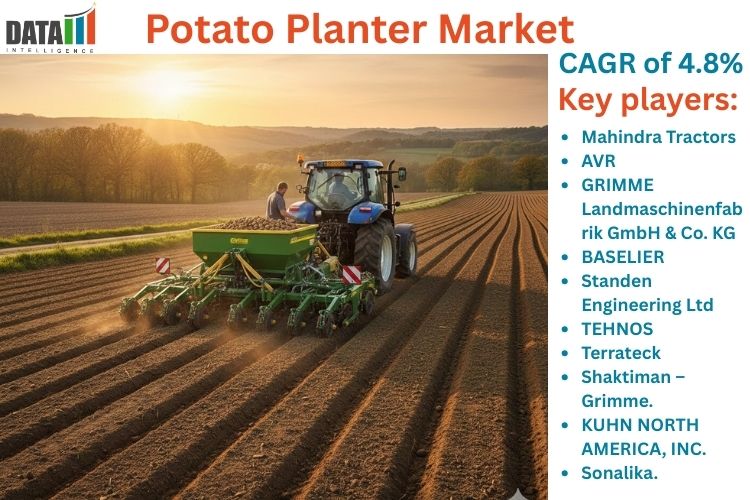
Potato Planter Market Size
The Global Potato Planter Market is expected to reach at a CAGR of 4.8% during the forecast period 2024-2031.
The Potato Planter Market is growing steadily, driven by farm mechanization, precision agriculture adoption, and rising demand for efficient, high-yield potato cultivation solutions.”
AUSTIN, TX, UNITED STATES, February 20, 2026 /EINPresswire.com/ -- Market Overview:— DataM Intelligence
The Potato Planter Market is gaining significant traction as mechanized agriculture becomes a priority across both developed and emerging economies. Potato planters are specialized agricultural machinery designed to automate the planting of seed potatoes at consistent depth and spacing, improving yield efficiency and reducing labor dependency. As global food demand rises and farm labor shortages intensify, farmers are increasingly adopting precision planting equipment to enhance productivity. According to DataM Intelligence, The Global Potato Planter Market was valued at approximately USD 330.2 million in 2022 and is projected to reach nearly USD 483.06 million by 2031, expanding at a CAGR of around 4.8% during the forecast period. Key growth drivers include the rapid adoption of farm mechanization, government subsidies for agricultural equipment, increasing commercial potato farming, and rising demand for processed potato products such as chips and frozen fries.
To Download Sample Report Here: https://www.datamintelligence.com/download-sample/potato-planter-market
The market’s expansion is strongly supported by the growing scale of commercial farming and technological advancements in precision agriculture. The automatic and semi-automatic planter segment currently leads the market due to its higher efficiency, improved seed placement accuracy, and reduced operational costs. Regionally, Europe holds a dominant share, driven by large-scale potato cultivation in countries such as the Netherlands, Germany, and France, along with strong adoption of technologically advanced farming equipment. Meanwhile, Asia-Pacific is emerging as a high-growth region due to expanding agricultural mechanization in India and China, coupled with government initiatives to modernize farming infrastructure.
Key Highlights from the Report:
The Global Potato Planter Market is projected to grow at a steady CAGR of 4.8% through 2031.
Automatic potato planters dominate due to precision planting and reduced labor costs.
Europe leads the global market, supported by large-scale mechanized potato farming.
Asia-Pacific is witnessing rapid growth due to government-backed farm mechanization programs.
Rising demand for processed potato products is boosting commercial potato cultivation.
Technological advancements such as GPS-enabled precision planters are reshaping the competitive landscape.
Market Segmentation:
The Potato Planter Market can be segmented based on product type, mechanism type, farm size, and end-user application. By product type, the market includes manual planters, semi-automatic planters, and fully automatic potato planters. Manual planters are widely used by small-scale farmers due to their affordability and simplicity, especially in developing economies. However, semi-automatic and fully automatic planters are witnessing higher adoption rates in large commercial farms due to their efficiency, uniform seed placement, and reduced seed wastage.
Based on mechanism type, the market is divided into belt-type planters, cup-type planters, and pneumatic planters. Cup-type planters are popular because they ensure consistent seed spacing and depth control, minimizing crop damage. Pneumatic planters are increasingly gaining attention due to their precision and ability to handle different seed sizes, aligning with modern precision agriculture practices.
In terms of farm size, small and medium-scale farms continue to represent a significant share in emerging markets, while large-scale commercial farms dominate equipment adoption in developed regions. The end-user segmentation includes individual farmers, agricultural cooperatives, and agribusiness enterprises. Agribusiness enterprises and cooperatives are increasingly investing in advanced potato planting machinery to maximize yield and meet processing industry demands.
Speak to Our Analyst and Get Customization in the report as per your requirements: https://www.datamintelligence.com/customize/potato-planter-market
Regional Insights:
Europe remains the leading region in the potato planter market due to well-established agricultural infrastructure and high mechanization rates. Countries such as the Netherlands and Germany are known for their advanced potato farming techniques, driving demand for innovative planting equipment. Strong export demand for processed potato products also supports equipment modernization.
North America holds a substantial market share, driven by commercial farming operations in the United States and Canada. The presence of large agribusinesses and high labor costs encourage farmers to adopt automated potato planters to improve operational efficiency and reduce dependency on manual labor.
Asia-Pacific is projected to witness the fastest growth during the forecast period. Countries like India and China are investing heavily in agricultural modernization to enhance food security. Government subsidies for farm equipment and rising awareness about yield optimization are accelerating the adoption of mechanized planting solutions.
Latin America is also experiencing moderate growth, particularly in Brazil and Argentina, where commercial potato farming is expanding. Meanwhile, the Middle East and Africa region is gradually adopting mechanized farming techniques, though growth remains slower due to limited infrastructure and financial constraints.
Market Dynamics:
Market Drivers
The primary driver of the potato planter market is the increasing demand for higher agricultural productivity amid shrinking arable land. Mechanized planting significantly improves seed placement accuracy, reduces crop damage, and ensures uniform germination. Additionally, labor shortages and rising wage costs are pushing farmers toward automation. The expansion of the processed food industry, especially frozen and snack potato products, is encouraging large-scale potato cultivation, thereby increasing the need for efficient planting machinery. Technological advancements such as GPS-guided systems and precision farming tools further support market growth.
Market Restraints
Despite promising growth, the market faces several restraints. High initial investment costs associated with advanced potato planters limit adoption among small-scale farmers. Maintenance expenses and the need for skilled operators can also pose challenges. In developing regions, limited awareness about modern farming equipment and inadequate access to financing options hinder widespread adoption. Furthermore, fluctuating potato prices and climate uncertainties can impact farmers’ investment decisions in agricultural machinery.
Market Opportunities
Significant opportunities exist in emerging economies where farm mechanization rates are still relatively low. Governments offering subsidies and favorable financing schemes for agricultural equipment create a supportive environment for market expansion. The integration of smart technologies, including IoT-enabled monitoring systems and data analytics for crop management, presents new avenues for innovation. Manufacturers focusing on cost-effective, compact, and multi-functional planters tailored for small and medium farms can tap into untapped rural markets. Additionally, the growing emphasis on sustainable agriculture encourages the development of energy-efficient and eco-friendly planting solutions.
Looking For Full Report? Get it Here: https://www.datamintelligence.com/buy-now-page?report=potato-planter-market
Frequently Asked Questions (FAQs):
How Big is the Global Potato Planter Market in 2026?
What is the Projected Growth Rate of the Potato Planter Market through 2033?
Who are the Key Players in the Global Potato Planter Market?
What is the Market Forecast for the Potato Planter Market by 2033?
Which Region is Estimated to Dominate the Potato Planter Industry during the Forecast Period?
Company Insights:
The competitive landscape of the Potato Planter Market is characterized by established agricultural machinery manufacturers focusing on innovation, product efficiency, and global expansion.
Mahindra Tractors
AVR
GRIMME Landmaschinenfabrik GmbH & Co. KG
BASELIER
Standen Engineering Ltd
TEHNOS
Terrateck
Shaktiman – Grimme.
KUHN NORTH AMERICA, INC.
Sonalika.
Recent Developments:
United States:
February 2026: New regulatory approvals sped up AI-integrated planters, with trials reporting 15% higher yields. This spurred investments, preparing growers for the 2026 season.
January 2026: Industry leaders announced subsidies for hybrid electric potato planters to align with federal sustainability mandates. Deployments in Midwest states showed reduced fuel use, positioning the U.S. for stronger exports.
December 2025: A major ag-tech firm launched affordable retrofit kits for existing potato planters, focusing on automation features tailored for smaller farms. This addressed supply chain issues from earlier tariffs, supporting a 10% uptick in regional equipment sales.
November 2025: U.S. manufacturers introduced advanced GPS-enabled potato planters to boost precision farming and cut labor costs amid rising wages. These models gained quick adoption in Idaho's key growing regions, enhancing planting efficiency by up to 25%.
Japan:
February 2026: Digital transformation initiatives integrated IoT into potato planters, enhancing data-driven farming. This positioned Japan for a 4% CAGR through 2035.
January 2026: A forecast update projected steady growth in seeder-planter demand, driven by export surges to Egypt. Domestic production hit 98K units, with new models emphasizing durability.
December 2025: Government-backed R&D unveiled compact planters suited for smallholder farms, responding to labor shortages. Adoption rose in Kyushu, aiding import substitution efforts.
November 2025: Japanese firms upgraded transplanter tech for potatoes, incorporating robotics for sloped terrains common in Hokkaido. Early tests improved planting speeds by 20%.
Unlock 360° Market Intelligence with DataM Subscription Services: https://www.datamintelligence.com/reports-subscription
Conclusion:
The Potato Planter Market is poised for steady growth as agricultural mechanization continues to transform global farming practices. Rising demand for processed potato products, increasing labor costs, and advancements in precision farming technologies are driving adoption across regions. While high initial investment costs remain a challenge, government support programs and technological innovation offer substantial growth opportunities. With Europe leading the market and Asia-Pacific emerging as a high-growth region, the industry is set to witness continuous development through 2032. Manufacturers focusing on innovation, affordability, and sustainability will be best positioned to capitalize on evolving market dynamics.
Related Reports:
Agricultural Implements Market
Agricultural Machinery Market
Sai Kiran
DataM Intelligence 4Market Research
+1 877-441-4866
Sai.k@datamintelligence.com
Visit us on social media:
LinkedIn
X
Legal Disclaimer:
EIN Presswire provides this news content "as is" without warranty of any kind. We do not accept any responsibility or liability for the accuracy, content, images, videos, licenses, completeness, legality, or reliability of the information contained in this article. If you have any complaints or copyright issues related to this article, kindly contact the author above.
