

Global Smart Indoor Gardening System Market Led by Europe as Gardena Expands Smart Solutions
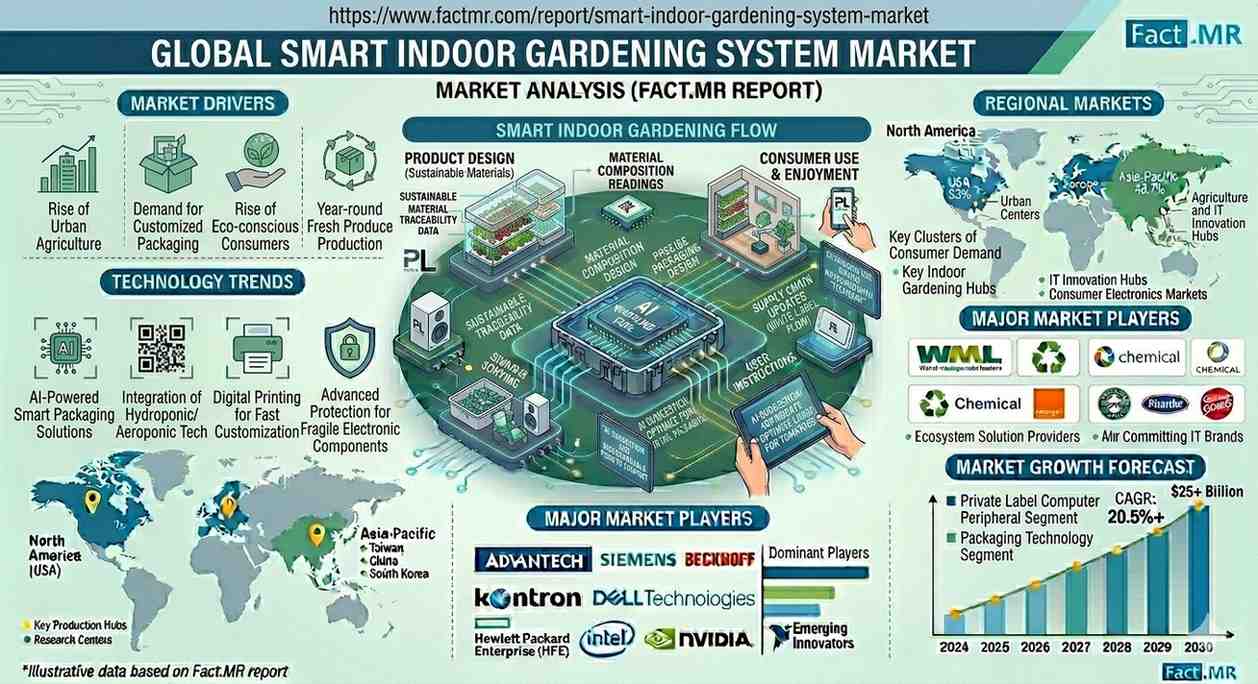
Smart Indoor Gardening System
Smart Indoor Gardening System Market is segmented by Type (Small Garden, Wall Garden, Others), Deployment (Self-Watering, Smart Sensing, Smart Pest Management)
ROCKVILLE, MD, UNITED STATES, April 7, 2026 /EINPresswire.com/ -- The global smart indoor gardening system market is entering a transformative era of hyper-growth, projected to expand from USD 3.2 billion in 2026 to USD 6.2 billion by 2036. According to the latest comprehensive analysis by FACT.MR, the market is set to advance at a compound annual growth rate (CAGR) of 6.3% over the next decade.As the global population becomes increasingly urbanized, the "indoor garden" has shifted from a niche hobbyist pursuit to a foundational smart home accessory. Driven by a convergence of IoT-enabled consumer electronics, localized food security concerns, and proactive wellness trends, these systems are redefining the modern living space as a productive, biophilic ecosystem.
Get Access Report Sample :
https://www.factmr.com/connectus/sample?flag=S&rep_id=14469
Executive Market Summary (2026–2036)
2026 Valuation: USD 3.2 Billion (Estimated)
2036 Projection: USD 6.2 Billion
Dominant Product Type: Small Garden Systems (47% Market Share)
Leading Technology: Self-Watering Systems (40% Market Share)
Key Driver: Hyper-Urbanization and AI-enabled Autonomous Cultivation
Strategic Segment Intelligence
The Rise of the "Countertop Farm"
Small Garden Systems lead the market with a 47% share, favored for their affordability and compatibility with apartment living. Major entries from LG Electronics and retail expansions by CLICK & GROW have solidified the "kitchen-integrated" appliance model.
Autonomous Cultivation & Deployment
Self-Watering systems command a 40% share, representing the most accessible entry point for mainstream consumers. The shift toward AI-enabled plant monitoring and fogponics (ultra-fine mist delivery) is drastically reducing the "knowledge barrier," allowing urban professionals to achieve high yields with zero agricultural expertise.
Regional Performance: Asia-Pacific as the Innovation Hub
The Asia-Pacific region remains the global volume leader, characterized by dense vertical living and state-backed agri-tech initiatives.
Country
Projected CAGR (2026-2036)
Strategic Driver
China
8.0%
14th Five-Year Plan support for urban ag and Gen Z "green lifestyle" trends.
India
7.6%
Metro air-pollution mitigation and "Botanics-as-a-Service" (BaaS) models.
Germany
7.0%
ESG corporate mandates and LEED/WELL office certification targets.
Brazil
6.5%
Bio-energy ecosystem integration and compact vertical living transitions.
USA
5.8%
USDA resilience grants (USD 14M+) and Matter/Alexa ecosystem maturity.
UK
5.1%
Post-Brexit food inflation and zero-waste "kitchen garden" solutions.
Competitive Landscape & Supply Chain
The market is moderately fragmented, with a fierce battle between tech-led startups and legacy home appliance giants.
Ecosystem Stickiness: Success is increasingly defined by subscription-based models (seed pods and nutrients) rather than hardware alone. Players like Gardyn, Rise Gardens, and AeroGarden are leveraging mobile app integration to increase customer lifetime value.
Appliance Integration: LG Electronics and BSH Home Appliances (Bosch) are leading the trend of floor-standing, furniture-grade units that blend seamlessly into premium interiors.
Supply Chain Dynamics: Vertically integrated players who control their own LED module and IoT sensor production hold a structural advantage in cost
control and rapid iteration.
Actionable Insights for Decision-Makers
Investment Opportunities
Institutional Wellness (B2B): There is significant growth potential in the "Nature Education" sector (schools) and hospitality hubs (farm-to-fork restaurants), where integrated wall-garden installations provide both aesthetic and functional value.
Advanced Fogponics: Innovations like Plantaform’s mist-delivery systems offer superior water efficiency and growth speeds, targeting the premium, tech-conscious segment.
Market Risks & Constraints
Energy Sensitivity: In regions like Europe, electricity costs remain a restraint for high-intensity LED systems, driving demand for "Eco-Mode" and solar-integrated units.
Long Replacement Cycles: Unlike consumables, the hardware carries a slower replacement cycle, making the seed pod subscription the primary engine for recurring revenue.
Future Outlook: The Biophilic Home
By 2036, the smart indoor garden will move beyond food production to become an integrated component of the home’s Climate Control System. Future units will likely act as "Natural Air Purifiers," carbon sinks, and humidity regulators, fully integrated into the Matter and Smart City infrastructures.
Browse Full Report –
https://www.factmr.com/report/smart-indoor-gardening-system-market
To View Related Report:
Smart Agriculture Solution Market https://www.factmr.com/report/smart-agriculture-solution-market
Smart Education and Learning Market https://www.factmr.com/report/smart-education-and-learning-market
Smart Personal Safety and Security Device Market https://www.factmr.com/report/smart-personal-safety-and-security-device-market
Smart Camera Market https://www.factmr.com/report/smart-camera-market
S. N. Jha
Fact.MR
+1 628-251-1583
email us here
Legal Disclaimer:
EIN Presswire provides this news content "as is" without warranty of any kind. We do not accept any responsibility or liability for the accuracy, content, images, videos, licenses, completeness, legality, or reliability of the information contained in this article. If you have any complaints or copyright issues related to this article, kindly contact the author above.
